Project results

Article: Funk E, Livkiss K, Andres Valiente B, Restuccia F. The hidden variable: how data gaps shape battery fire safety engineering. Fire Technol. 2026;62:147. doi:10.1007/s10694-026-01977-1.
Article: Funk E, Livkiss K, Andres Valiente B, Rein G, Restuccia F. Lithium-ion battery design fires in performance-based fire safety engineering: a review and scenario cluster framework. J Loss Prev Process Ind. 2026;102:106021. doi:10.1016/j.jlp.2026.106021.
Article: Funk E, Andres Valiente B, Eriksen CB, Cruz-Cardona C, Livkiss K, Restuccia F. Thermal runaway and fire behavior of large-format prismatic LFP cells under external heating and overcharge conditions. J Loss Prev Process Ind. 2027;105(Pt 1):106161. doi:10.1016/j.jlp.2026.106161.
Article: Funk E, Restuccia F. Decision making under uncertainty in fire safety engineering: An industrial Battery Energy Storage System Round Robin Study, submitted to J Loss Prev Process Ind.
Project informations
Status:
Ongoing
Period:
October 2024 to October 2027

Elena Funk
Research Consultant
Lithium-ion batteries are increasingly integrated into the built environment through battery energy storage systems, electric vehicles and small mobility devices. Their increasing use introduces fire hazards that differ from those associated with conventional fuels. Thermal runaway can result in rapid heat release, toxic and flammable gas emissions, fire propagation and potential deflagration, creating new challenges for fire safety engineering.
Performance-based fire safety design relies on the definition of credible design fires to represent the fire scenarios that a building or system may experience. For lithium-ion batteries, however, there is currently no consistent methodology for defining these scenarios. Available experimental data vary considerably, while current standards and guidance provide limited support for selecting and justifying parameters such as heat release rate, gas composition and propagation behavior.
From battery fire behavior to engineering design scenarios
In collaboration with King’s College London’s Heat and Fire Lab, this PhD project aims to develop a structured methodology for defining credible battery design fires. The research combines scientific literature with the experience of practicing fire safety engineers to understand how battery fire scenarios are currently defined, which information is needed in practice, and how engineers make design decisions when relevant data are uncertain or unavailable. A Round Robin study is used to investigate how different engineers select and justify input parameters when addressing the same battery fire problem.
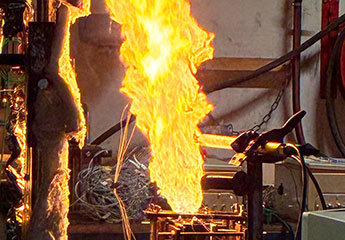
Experimental research complements this work by investigating how battery material composition, design and abuse conditions influence fire behavior. Small-scale experiments and material characterisation are used to study parameters including heat release rate, temperature and flame behavior under conditions such as overheating and overcharging. The project also investigates available in literature gas composition data from battery fires and their influence on flammability and toxicity calculations.
The results will be brought together in a methodology that integrates available data, experimental evidence and engineering judgement. The aim is to give fire safety engineers a transparent and defensible basis for identifying relevant battery fire scenarios and documenting the assumptions used in performance-based fire safety design.
The project's three objectives
The project has three overall objectives:
- To establish how battery design fires are currently defined in research and engineering practice, and to identify the data, knowledge gaps and uncertainties that influence their definition.
- To investigate how battery materials, design and abuse conditions influence key fire characteristics, including heat release rate, temperature, flame behavior and gas composition, and how variability in available data affects fire safety assessments.
- To develop a structured methodology for identifying, defining and justifying credible battery design fires for use in performance-based fire safety engineering.
Terms of use of the DBI website
Copyright © All material on DBI's website is protected by copyright law. If you are in any doubt about how to use our material, feel free to contact us at dbi@dbigroup.dk.
Copyright © All material on DBI's website is protected by copyright law. If you are in any doubt about how to use our material, feel free to contact us at dbi@dbigroup.dk.

