
Don't let your maritime fire test become a bottleneck
Download our free guide and get practical advice on streamlining your documentation process.
Download our free guide and get practical advice on streamlining your documentation process.
Surface materials and primary deck coverings used on ships must limit flame spread across exposed surfaces during fire exposure. Surface flammability testing is part of the reaction-to-fire requirements for materials used in marine applications.
DBI performs surface flammability testing of marine surface materials and primary deck coverings according to IMO fire test procedures.
The testing evaluates how exposed surfaces contribute to flame spread under controlled fire conditions.

Relevant standard:
Typical applications:
Documentation:
Surface flammability testing evaluates how fire spreads across exposed material surfaces during fire exposure. The testing focuses on the surface behaviour of the material itself rather than the fire resistance of the underlying construction.
The evaluation documents:
The purpose is to document whether exposed surfaces contribute to flame spread in marine interiors.
The testing can include coatings, laminates, films, adhesives and other exposed surface materials used in marine interiors.
A primary deck covering is the first layer placed directly on top of the ships steel deck, and is evaluated according to the same test principles.

Our 3,000 square meter headquarters near Copenhagen houses a modern fire laboratory with various furnaces for almost all types of fire tests.
This makes it possible for us to conduct almost all types of fire tests, from small-scale to full-scale, with items as high as 4.48 meters.
Watch the video of some of our fire testing facilities.
Mark works closely with our fire testing engineers within the maritime sector, and he will be happy to assist you with your enquiry and connect you with the right team.

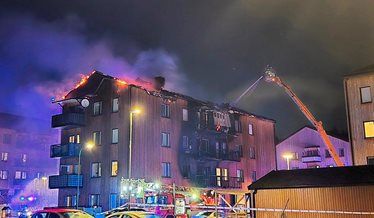
A facade fire in Sweden last year led to an investigation of the building and several fire tests of the facade materials. A Swedish report now concludes that the tested materials did not perform as expected, but that the cause of the failure cannot be established. The report therefore recommends further research to obtain better documentation of the durability of the fire performance of fire-retardant-treated timber facades.

What classification does your product need? How can you develop it quickly and cost-effectively? And what is the best order to tackle the process? Download DBI's new free guide for practical advice on how to achieve the best results with your maritime fire testing.

As the number of batteries in our society increases, so does the need for knowledge about fire risks and safety. Therefore, DBI has developed new test facilities that make it possible to conduct fire tests of batteries under safe and controlled conditions.

With the accreditation of DBI’s new laboratory for testing fire detection systems, it is now possible to meet the high demand in this area.

A fire door is not a smoke control door, and a smoke control door is not a fire door. A lack of knowledge about the difference remains a challenge for fire safety in construction, but divided classification shows how smoke control doors are tested.

A new study shows how unprotected steel in hybrid steel-timber (HST) floor cross-sections can act as a heat transfer pathway during a fire, increasing charring of the timber in HST connections. However, appropriately designed intumescent coating of the exposed steel surface can prevent this damage under standard fire exposure.

A new white paper from DBI demonstrates how infrared machine vision and data processing uncover hidden variations in insulation materials during fire-exposure testing – and points to a method that could transform testing of other construction products.

In December, emergency services extinguish twice as many living-room fires as in the other months of the year. A well-watered Christmas tree keeps its festive glow and significantly reduces the risk of fire, according to a new fire test conducted by DBI and Danish Emergency Management Organisation.

Most test laboratories can test two or three fire dampers at a time. But with new testing equipment, DBI can now conduct fire tests on four dampers simultaneously. This makes the process both faster and cheaper for manufacturers.

Which classification does your product need? How can you develop your product quickly and cost-effectively? What specifications does the fire laboratory need before your fire test? See DBI’s new free guide, and get useful tips on how to complete your fire test and project in the most efficient way.

Until now, little has been known about how modern multi-pane low-energy windows behave in fully developed fires. Fire models have often assumed complete glass fallout. However, new furnace tests conducted at DBI by researchers from DTU and DBI now show clear differences: Double-glazed windows exhibited significant fallout, while triple-glazed panes largely remained in place.

Europe lacks facilities for testing fire detection systems. DBI is now changing that with a new state-of-the-art laboratory and a new accredited testing area.

Postdoc Guoxiang Zhao is working to improve computer simulations of fire in a facade. A new scientific article brings simulations one step closer to the ultimate goal: reducing the number of failed fire tests and shorten products’ time-to-market.

DBI and FORCE Technology have acquired the company 3P Third Party Testing ApS and will henceforth continue the company’s activities within their respective core areas.

A new and revised European standard for fire testing of building covering will take effect on 31 January, 2026. However, DBI encourages manufacturers to test according to the revised standard already now. The new standard will provide a more uniform safety level across countries, as well as new, flexible opportunities for manufacturers.

With the BioFacades:UpHigh project, DBI (The Danish Institute of Fire and Security Technology) has gained valuable knowledge about material use, and the first developers are already applying the project’s findings to real construction projects. This marks an important step toward widespread use of bio-based facades in taller buildings.

Three powerful impacts after the classification test are part of DBI’s new fire test, the Impact Test. This test is used for walls in industrial and warehouse buildings, where there may be an increased requirement for wall robustness in the event of a fire.

DBI and door manufacturer Jeld-Wen are analyzing and documenting the fire resistance of reused fire doors through the ReDoor project. They are also developing documentation methods and possibilities for certification. Initial fire tests show that both old doors and artificially worn doors perform convincingly.

As part of a so-called MUDP project, DBI has conducted three scaled-down facade tests of different straw constructions types. Consequently, adjustments will now be made to one or more of these constructions before further testing is carried out. The goal is to make it feasible to use biogenic materials in multi-story modular construction.

DBI has tested and demonstrated that a biogenic cladding wall’s fire resistance can meet the EI 30 fire classification. The scalability of the project now makes it possible to fire-protect a wide range of biogenic insulation materials with the tested construction.

DBI has combined a range of strong expertise to design custom-made fire testing equipment, enabling AkzoNobel to fire-test their own products during the development process. This allows them to get faster and cheaper indications of their products' fire-related properties.

New study finds that a fire in a mass timber compartment is less likely to auto-extinguish when the exposed surface is more than 20 % of the total surface area.

It is significant whether wood is fire-impregnated before or after it is cut into panels. Additionally, the material onto which the panels are mounted is of crucial importance for the fire properties of the panels. This was demonstrated by four comparative SBI fire tests conducted by DBI in collaboration with Burnblock.

Halfway through the Biofacades:UpHigh project, the short conclusion is: Wooden facades burn well – but it is certainly possible to build bio-based facades.

We need more climate and environmentally friendly solutions in construction. Therefore, DBI is involved in a new project to develop and fire-test prefabricated structures in biogenic materials scaled for multi-storey construction.

DBI – the Danish Institute of Fire and Security Technology has tested a solution based on early detection and a water mist system for multi-storey and underground car parks. The fire test shows that the solution can prevent the spread of an electric vehicle fire to vehicles parked alongside for at least 30 minutes.

The third construction in DBI’s BioFacades:UpHigh easily passed a full-scale facade test. This was preceded by a number of downscaled fire tests and adjustments along the way, which proved to be very successful.

11 megawatts. This is the power output of DBI’s large multi-furnace. In addition, it can fire test specimens measuring 5 x 3 metres. This offers some unique opportunities and is difficult to find anywhere other than at DBI – The Danish Institute of Fire and Security Technology.

The test standard for walls with wooden panels has previously been inadequate, which has made it impossible to classify the panels. Years of work by DBI (The Danish Institute of Fire and Security Technology) has now made the test standard more accurate and enabled classification.

The first full-scale facade test in the BioFacades:UpHigh project has just been conducted at DBI. After 11 ½ minutes, the fire reached above the second flame deflector, and the construction failed the test. A further nine tests will follow in the project, which will shorten the path for sustainable facades in multi-storey buildings and result in actual facades being built in Denmark.

DBI has successfully conducted 39 indicative small-scale fire tests on 14 different bio-based structures. This forms part of the ‘Fireproof Bio-Based Structures’ project.

The burn rate of recycled wood – regardless of its age – remains within the Eurocode 5 limit values and thus does not differ from new CE-marked wood in terms of fire safety. The Spireprojekt Upcycling Orangeri 2.0, which was recently completed, has proved this. The next step is to find non-destructive methods for evaluating the wood.

A Danish company has tested the usability of its EV Firefighter in collaboration with DBI. The documentation is of great value to the Danish company in a new world market, which has a strong focus on finding ways to extinguish fires in electric cars.

Fires in electric or hybrid vehicles cars on ferries pose a new, special risk. But it can be handled with the right additions to the existing emergency preparedness on board. This is the conclusion of the ELBAS project, which has been led by DBI.

As part of the Wood:UpHigh project, DBI has recently carried out a fire resistance test of a wall construction with primarily bio-based materials. The wall passed 71 minutes (REI60) before the insulation collapsed.

“It’s ambitious, it’s brave, it’s bold.” And: “Through experimentation and cross-disciplinary collaboration, insight, learning and useful results are achieved that can lead to radically new sustainable directions for construction”.

Solar panels mounted on flat roofs can spread fire in the gap between the roof and the panel. Jens Steemann Kristensen, who is a Research Consultant at DBI – the Danish Institute of Fire and Security Technology, has written a PhD thesis on the issue.

DBI – The Danish Institute of Fire and Security Technology has recently conducted extensive testing into the detection and extinguishing of battery fires in electric cars on vehicle decks in ferries. It took place in a structure consisting of 40-foot containers. Read some of the preliminary experiences and recommendations.

The plastic used in, for example, wheelchairs and dialysis equipment, in electronics and in trains, must adhere to certain standards of flammability and thus also to the methods used to test it. With its new test facility, DBI can now test smaller components in accordance with, for example, the UL94 standard.

It is not perfect, but it is a big improvement. A draft proposal has been put forward for a common European standard for testing building facade systems, and even though it has some flaws, there are grounds for optimism.

This autumn, a new calorimeter arrives at DBI's fire lab. It will be used for small scale trials of materials before testing in full scale. And it can mean substantial savings for manufacturers.

Our headquarters and test facilities are centrally located in Copenhagen, Denmark – close to the motorway and only a 15-minute drive from Copenhagen Airport.

